Humanizing war data through an XR and a LLM AI agent experience
Situation and Tasks
One death is a tragedy. A million deaths is a statistic. This concept, also known as Compassion Fade, describes how human empathy diminishes as the scale of suffering grows. This project aims to reduce Compassion Fade related to the large, abstract, and distant numbers of war-caused casualties.
Its execution lasted 4 months: from February 2020 to July 2020. During that period of time, most of the news showed COVID-19 deaths in thousands. Since the situation directly appealed to individuals, the Compassion Fade perception was absent, as there was strong alignment with the closest reality. However, would the Compassion Fade come back again? Can we make large numbers approachable? War Owned approaches this question by experience rather than argument.
In 2026, wars are still happening. The project again revisits the topic of communicating war data by building an agent on the Claude API, with prompt and dialogue design, an interaction model, visual language, and front-end implementation, all owned end-to-end.


Actions: Literature Research
The project draws on the Identifiable Victim Effect. This psychological principle arises from the fact that, although humans have two coexisting ways of thinking (rational thinking, grounded in data and facts, and experiential thinking, grounded in emotions), numerous researchers agree that experiential thinking has more impact on behavior, which leads to the Singularity Effect: people identify with and emotionally relate to a single individual rather than a group or large number of people.
The Singularity Effect, combined with the Vividness Factor (which suggests that individuals respond better to specific interactions and graphic information), served as the main theoretical framework for this project. Combined with the main conflict data from ongoing wars in Syria, Yemen, Afghanistan, or the Cartel wars of Mexico, this framework pointed toward a design to diminish Compassion Fade: an experience to make individual stories visible within statistics.

Actions: Qualitative Research

Results and Impact: XR
The design solution required a specific setting that would help the audience connect instantly with the narratives collected.
In Barcelona's Gothic district, there is a small and quiet square where there are still shrapnel marks from a bomb that exploded during the civil war, almost 90 years ago: "Plaça Felip Neri." Today, people gather here to have intimate conversations, without considering that this square was a conflict zone. This historical place was the perfect location to host the exhibition of war human narratives.
The format adds a living layer on the spot, giving evidence that, although visitors are not physically in a war zone, others are currently living in it. Extended Reality was the most appropriate format to express it for three different reasons: it erases the distance between visitors and active conflicts directly in a place where reality shows the marks of war; it addresses the Vividness Factor through live conversations with people who are living in a conflict area; and finally, it combines the experiential layer with general statistics of the conflict, engaging both rational and experiential thinking at the same time.
Results and Impact: AI
The exhibition ran for three weeks at Plaça Felip Neri, welcoming approximately 530 visitors. Furthermore, the project was awarded the Laus Award for Visual Digital Design by the Spanish Association of Graphic Design in 2021.
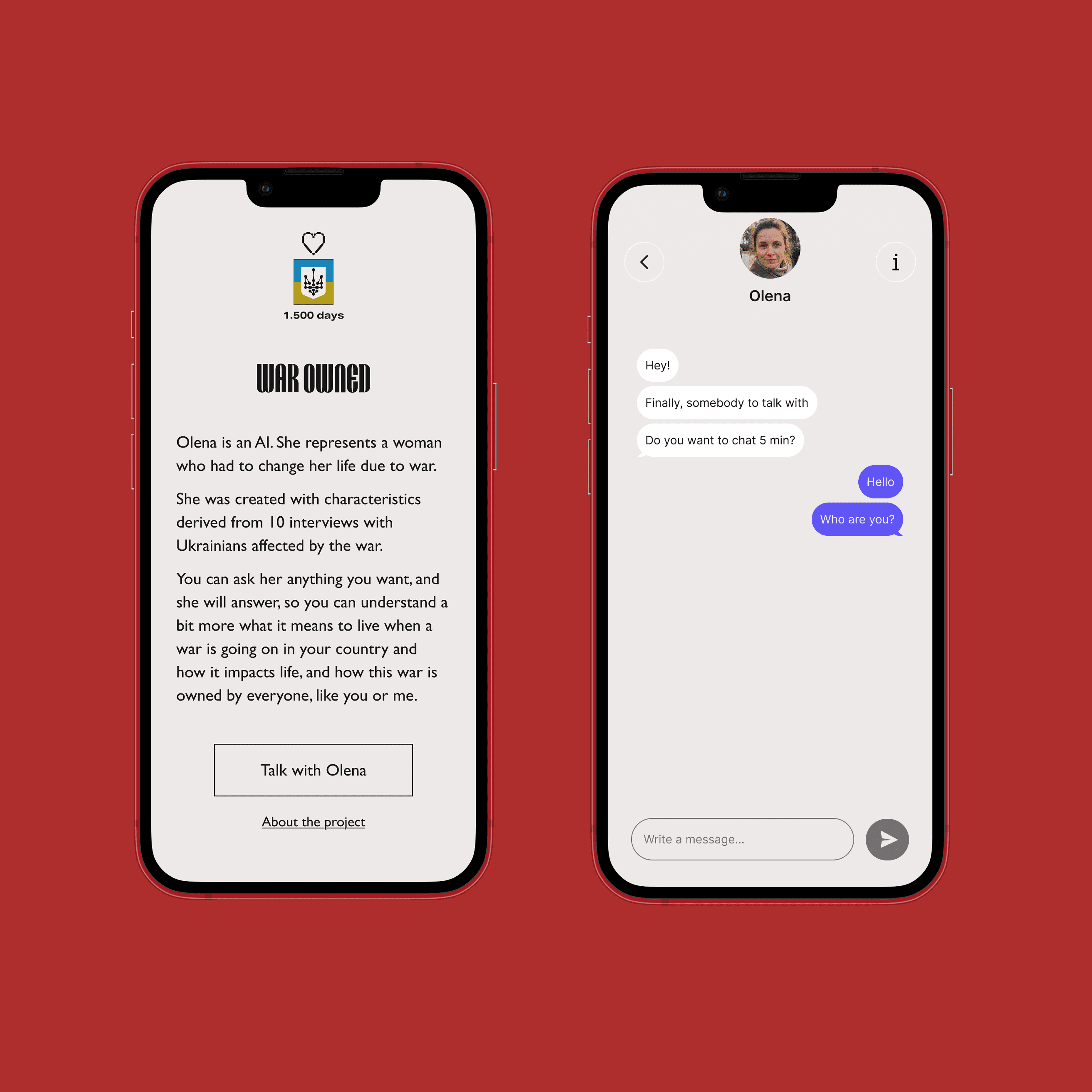
As global conflict has intensified, War Owned has evolved into a new experience that applies the same design principles: address the Vividness Factor, explore general statistics about conflict, and diminish the distance individuals feel from it through AI.
The Ukraine conflict has been going on for more than 1,500 days. However, since people are used to it, they may feel desensitized when hearing news about this war. To increase accountability for this situation, the project offers a custom AI agent via the Claude Platform API and a Persona profile derived from 10 qualitative interviews with Ukrainian families. You can check the results on this webpage: war-owned.com.
One death is a tragedy. A million deaths is a statistic. But somehow, LLM statistics can be a great tool for transforming a large number of people back into a single person, entering a new paradigm where it becomes possible to humanize large statistics and, therefore, dissolve the Compassion Fade.